A friend of mine recently showed me photos of a house in Mission Hills that backed up to one of the canyons, and my first thought was that I would absolutely drink my coffee out there every morning. My second thought, after seeing the backyard from a different angle, was that I would have no idea what to do with the giant slope disappearing behind it.
That is apparently the tradeoff with some of the best views in Mission Hills. The canyons make these properties beautiful, but they also turn what looks like a normal landscaping project into something involving slopes, drainage, fire safety, and whatever is growing on the other side of the fence.
As somebody whose landscaping knowledge normally tops out around remembering which plants I forgot to water, I had never really thought about how much the land itself dictates what you can build. A canyon-edge yard is a pretty good example of why the answer is sometimes “a lot.”
You Can’t Pretend the Hill Isn’t There
The first problem is obvious once you stand in the backyard: canyon lots tend to slope.
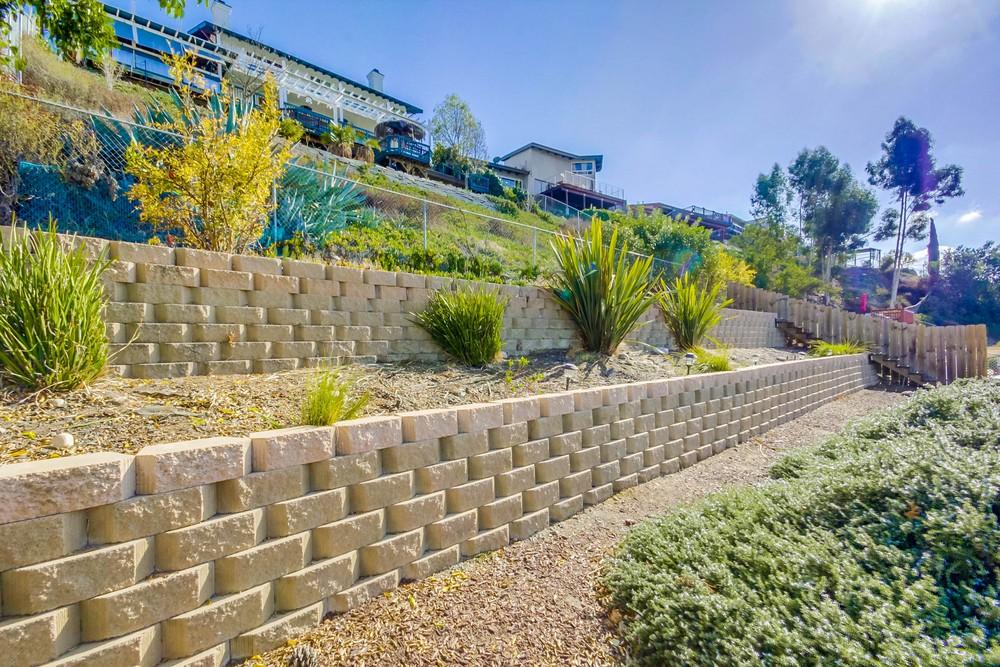
If you want a patio, lawn, entertaining area, or somewhere reasonably flat for your kids to run around, some of that grade may need to be managed. Terraces and retaining walls can create usable levels instead of leaving half the property as a hillside nobody knows what to do with.
I used to think of retaining walls mostly as decorative landscape features. In reality, once a wall is holding back a meaningful amount of soil near a slope, things like foundations, drainage, engineering, and permits start entering the conversation.
That is especially important close to a canyon edge, where changing the grade can affect more than whether the patio looks nice. Done correctly, terracing can make the yard much more usable while still allowing the landscape to step naturally toward the view.
Then You Have to Figure Out Where the Water Goes
This was the part that made the most immediate sense to me because water always finds the one place you did not want it to go.
A canyon-edge property collects runoff from roofs, patios, irrigation, and whatever else happens during one of San Diego’s occasional real storms. If all of that water gets concentrated in one place and sent down the slope, erosion can become a much bigger problem than a muddy patch in the yard.
The soil underneath the landscaping can complicate things too. Mission Hills properties can have dense soils, sandstone, and other subsurface conditions that make excavation harder and limit what can simply be planted wherever somebody thinks it looks good.

That means drainage and irrigation have to be planned along with everything else. Drip systems and separate irrigation zones can deliver water where plants need it without continually soaking a hillside that you would really prefer to stay where it is.
For me, this is one of those home projects where the invisible part suddenly seems much more important than the fun part. Picking plants and patio materials is enjoyable, but none of it matters much if the water underneath them is slowly creating a problem.
Living Next to a Canyon Also Means Living Next to Brush
The other thing I had not considered is fire.
Mission Hills can feel completely residential when you are driving through it, but canyon-edge homes may sit directly next to native or naturalized vegetation. San Diego has brush-management requirements for properties where structures meet that kind of open space, which means the area between the house and canyon has to be maintained with fire safety in mind.
That does not mean homeowners should go outside and strip every plant off the slope. Vegetation also helps hold soil in place, and canyon habitat can come with biological considerations that affect when and how work should be performed.
The planting closest to the house deserves particular attention. Lower-fuel, well-maintained landscaping and appropriate hardscape can help create defensible space without turning the backyard into a gravel lot.
I would not have known to ask about any of this before talking to someone who works on these properties. I probably would have been staring at Pinterest pictures and wondering where the lemon tree should go.
The Canyon Is Still Part of the Property Experience
There is another reason not to treat everything beyond the fence as somebody else’s problem. Plants have an annoying habit of ignoring property lines.
Some ornamental plants can spread into San Diego canyons and compete with native vegetation, so choosing non-invasive landscaping near the edge matters. What gets planted in one backyard can eventually become part of the slope below it.
The view should influence plant placement too. If the whole reason you fell in love with the house was that open canyon panorama, planting something along the rear property line that eventually becomes fifteen feet tall seems like a fairly expensive way to undo your own selling point.
Lower plantings near the edge can preserve those sightlines while taller trees and shrubs frame them from elsewhere in the yard. The canyon is already doing a lot of the visual work for free, so the landscape does not need to compete with it.
This Is Where the Contractor Matters
This is also one of those projects where I would be much more interested in what a contractor knows than how pretty their Instagram feed looks.
When comparing companies for landscaping San Diego canyon properties, I would want to know whether they regularly work with slopes, retaining walls, drainage, erosion control, and brush management. I would also ask exactly what happens to the runoff once the new patio, walls, and irrigation are installed.

Torrey Pines Landscape Company handles design and construction through the same team, including grading, drainage, irrigation, hardscape, permitting, and landscape design. That kind of coordination makes a lot more sense to me on a property where moving one thing at the top of the yard can create another problem farther down the hill.
The right Mission Hills landscape contractors are not simply filling a backyard with attractive materials and plants. They are figuring out how to make the yard more useful without creating problems with the slope, water, fire exposure, or canyon below.
The View Comes With a Little Homework
I still think I would happily drink my coffee overlooking one of those Mission Hills canyons every morning. I would just have a much longer list of questions before deciding what to do with the backyard.
A canyon-edge property gives homeowners something most yards never will: an open landscape stretching well beyond the property itself. Keeping that view beautiful means working with the grade, managing water carefully, planning for fire safety, and remembering that the canyon is part of the design whether it technically belongs to you or not.
Torrey Pines Landscape Company
+18584541433
5560 Eastgate Mall, San Diego, CA 92121